Heleo4 LED Light therapy
LED light across nine modes — from antibacterial blue to deep-repair infrared — paired with a chlorella complex. Calm, cumulative, usually no downtime.
Key facts
- Who you’ll see
-
- Kateryna Petliuk Head of Non-Invasive Cosmetology
- Where
- CREAMÉ, 350 Al Wasl Road, Jumeirah 1, Dubai
- Session
- 20–40 minutes
- Numbing
- Not needed
- Downtime
- Usually none
- Course
- 5–10 sessions, one or two a week
- Device
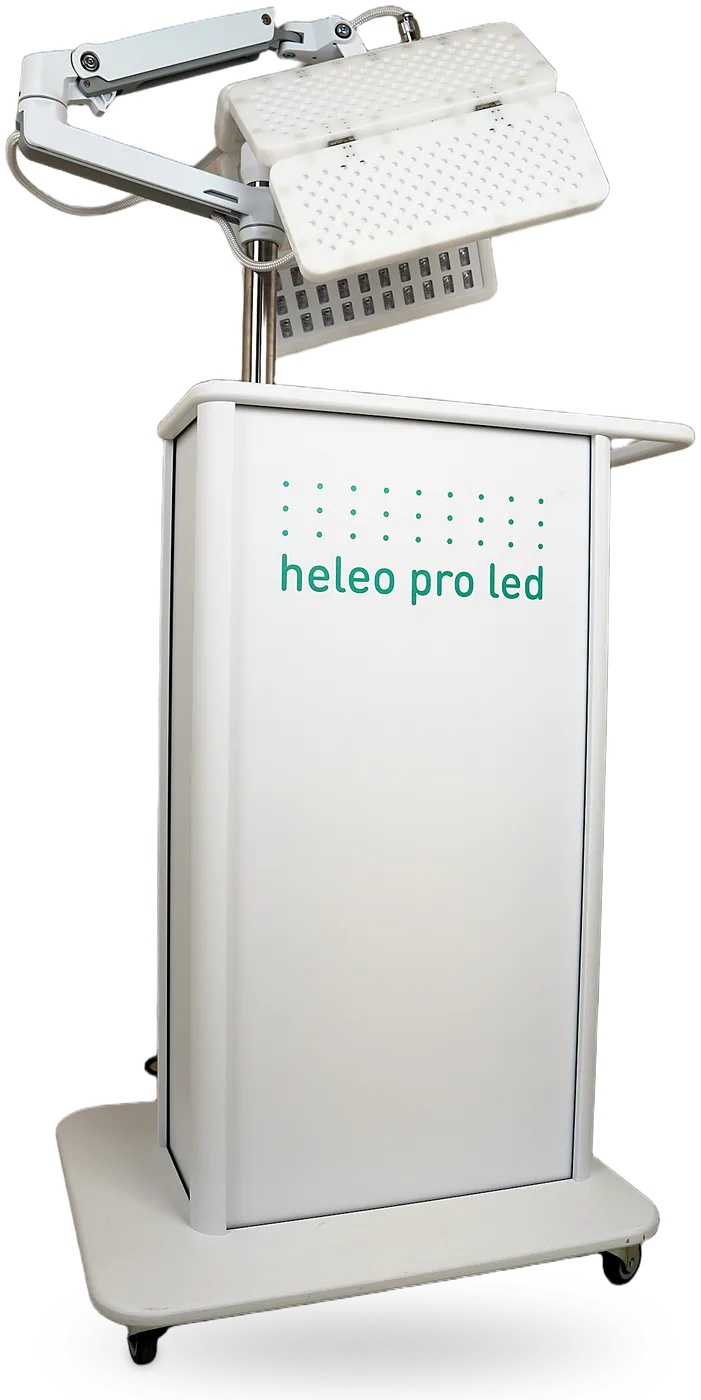
- Heleo4 LED by ZXA Group, Bulgaria LED light from 420 to 740 nm, with a chlorella complex
Heleo4 LED by ZXA Group, Bulgaria
LED light from 420 to 740 nm, with a chlorella complex
What Heleo4 LED is for
Breakouts and congested skin, redness and reactivity, skin recovering from procedures — the concerns driven by inflammation more than by age.
Concerns it may help with
How Heleo4 LED works
Photobiomodulation: LED light at precise wavelengths — from antibacterial blue at 420 nm through calming green and collagen-stimulating red to deep-repair near-infrared at 740 nm — absorbed by the cells' energy machinery to lower inflammation and speed repair. A chlorella-based complex is applied first so the light works on prepared skin. No UV, no heat damage, no abrasion.
A session, step by step
- We start with what your skin is reacting to, a look at it, photographs in the same light each time, and a check of your health and the medicines you take, since some make skin more sensitive to light.
- The skin is cleansed and prepared with a gentle enzyme exfoliation, then the chlorella-based complex goes on.
- Your eyes are protected and the light panel is set over your face: 20 to 40 minutes of comfortable, slightly warm light, in the colours chosen for your skin. No numbing is needed, and many people doze off.
- A light moisturiser and sunscreen to finish.
What to expect
How it feels
Twenty to forty minutes of comfortable, slightly warm light with your eyes protected. People routinely fall asleep.
Downtime
Usually none — skin often leaves calmer than it arrived. Daily SPF, and go easy on strong actives for a day or two.
How many sessions
Light works cumulatively: a course of five to ten sessions, one or two a week — eight to ten for acne and rosacea-prone skin — then maintenance every three to six weeks. Skin is usually calmer after the first session; the visible change arrives over three to five.
Who it may not suit
We go through your health and medicines first, because Heleo4 LED may not suit you, or may need to wait, if any of these apply:
- You have a condition that makes your skin react to light.
- You take a medicine or supplement that makes skin more sensitive to light, such as isotretinoin, some antibiotics or St John's wort: tell us everything you take.
- You have had seizures or migraines set off by light.
- You are pregnant or breastfeeding.
- There is an active infection or dermatitis in the area.
- You have melasma or other darker patches that are still active: we plan the light with care, or wait.
- You have reacted to skincare ingredients before: the complex applied first is chlorella-based, and we check it with you.
Risks and side effects
Common and mild: warmth during the session, and some redness or dryness afterwards.
Less common: stinging or light flaking.
Uncommon, but important to know: changes in pigment. Blue light can cause lasting darker patches in medium and deeper skin tones (in research, from skin type III up), so on pigment-prone skin we lean on the other colours and keep to strict sun protection.
In trials, the side effects of LED light have been mild, but most trials were small and short, so the long-term picture is less certain.
Aftercare
- Sunscreen every day, reapplied when you are out in Dubai's sun, especially if your skin marks easily.
- Go easy on strong actives, such as exfoliating acids, retinoids and scrubs, for a day or two.
- Keep to the skincare or medical treatment planned for acne or rosacea: light supports it rather than replacing it.
- Tell us before your next session if your skin stung, flaked or darkened, or if you have started a new medicine.
How pricing works
We don't publish prices. The cost depends on the number of sessions in your course and on whether light is part of a wider plan, such as recovery after another treatment, which we decide together at the consultation. You know the full plan and its cost before you start, and we suggest only the sessions your skin calls for.
Our take
Light is slow, gentle care — strongest on inflamed and recovering skin, and honest about what it isn't.
It will not lift, fill or resurface, and we won't sell it as if it could. Where it earns its place is calming reactive skin, shortening recovery, and keeping acne-prone skin steady between bigger decisions — the quiet supporting work.
Questions people ask
Does LED light therapy help acne?
It can help as part of a plan, but the evidence is mixed. A review of randomised trials graded the evidence for blue and red LED light in acne B on an A-to-D scale, while a meta-analysis of blue light alone found the trials too small and short to show a clear effect on spot counts. So we use it alongside your skincare or medical treatment, not instead of it, and judge it against your photographs. For acne, the review suggests two sessions a week for four to eight weeks.
Can LED help my skin recover after another treatment?
That is one of its better-supported uses. In the same review, LED light was graded B for helping recent wounds heal, and in two small trials, yellow light used straight after laser or pulsed-light treatment reduced redness over the following day; in one, the difference had gone by a week. We time it with the treatment it supports.
Is Heleo4 LED suitable for darker skin?
Usually, with care. It uses no UV and doesn't injure the skin, but blue light can cause lasting darker patches in medium and deeper skin tones, so we choose the colours for your skin and keep to strict sun protection.
Can LED replace laser or medical treatment?
No. Light will not lift, fill or resurface, and its maker says Heleo4 is not a medical treatment. We use it to calm reactive skin, support recovery and keep acne-prone skin steady, alongside the treatment your skin needs.
Can I have LED in the Dubai summer?
Yes. It uses no UV and causes no heat damage, and its maker describes it for use all year. Keep up daily sunscreen, especially if your skin marks easily.
How much does an LED light facial cost per session?
We don't publish prices, per session or for a course. The cost depends on how many sessions your skin needs, usually five to ten in a course, and on whether light is part of a wider plan, such as recovery after another treatment. We set this together at the consultation, and you know the full plan and its cost before you start. We suggest only the sessions your skin calls for.
Where can I have an LED facial in Dubai, and how do I choose an LED light therapy clinic?
With us at CREAMÉ, 350 Al Wasl Road, Jumeirah 1, in our Cosmetology division, where you'll see Kateryna Petliuk, our Head of Non-Invasive Cosmetology, who specialises in acne and skin restoration. Wherever you go, check that the clinic is licensed, and expect questions before the light goes on: what your skin reacts to, the medicines and supplements you take, and whether you have melasma or skin that darkens easily. You should also be told plainly when acne needs a doctor first.
What is LED light therapy good for on the skin, and what are the benefits of blue and red light in an LED facial?
Mainly calming skin driven by inflammation: breakouts, redness, reactive skin and skin recovering from a procedure. By colour: blue light, at 420 nm, acts on the bacteria involved in acne; red is thought to calm inflammation and stimulate collagen; near-infrared is used for repair, and green to calm reactive skin. In two small trials, yellow light after laser or pulsed light reduced redness over the next day. Blue can cause darker patches on medium and deeper skin tones, so there we lean on the other colours.
What side effects can an LED light facial have, and are my eyes protected?
Usually mild ones: warmth during the session, then some redness or dryness; less often, stinging or light flaking. The one to know about is pigment: blue light can cause lasting darker patches in medium and deeper skin tones, so on skin that marks easily we lean on the other colours and keep to strict sun protection. Your eyes are protected throughout. Tell us if light has ever set off a seizure or migraine, and about every medicine and supplement you take, since some make skin more sensitive to light. In a review of 31 randomised trials, side effects were mild and none were severe, though most trials were small and short.
Does LED light therapy really work, and when do the results of an LED facial show?
It can, for the right concern. In a review of randomised trials, the evidence was stronger for acne and for healing after procedures than for lines and texture. Skin is usually calmer after the first session, and visible change tends to come over three to five. The effect can fade without upkeep: in one small trial of red light for acne, 21 of 22 people said their acne had come back within two months of stopping. So after a course we plan maintenance every three to six weeks.
Is there downtime after an LED light facial, and what aftercare does it need?
Usually none: skin often leaves calmer than it arrived, though some people have a little redness or dryness for a while. Aftercare is simple. Wear sunscreen every day and reapply it when you are out in Dubai's sun, especially if your skin marks easily. Go easy on strong actives, such as exfoliating acids, retinoids and scrubs, for a day or two, and keep to the skincare or medical treatment planned for acne or rosacea. Tell us before your next session if your skin stung, flaked or darkened.
How long is an LED light facial, how many sessions will I need, and how often?
The light itself takes 20 to 40 minutes, once your skin has been cleansed, gently exfoliated and prepared with the chlorella complex. Light works cumulatively, so a course is usually five to ten sessions, one or two a week, or eight to ten for acne and rosacea-prone skin. After that, maintenance every three to six weeks can help keep the effect. We suggest only the sessions your skin calls for, and review the plan against your photographs as you go.
LED facial vs HydraFacial: what is the difference, and can I have both?
They do different jobs. An LED facial uses light at set colours, after a chlorella complex, to calm inflammation and support repair, so it suits red, sore breakouts, reactive skin and skin recovering from a procedure. The HydraFacial cleanses, extracts and hydrates with water and suction, so it suits blackheads, congestion and dull, dehydrated skin; its longer version ends with a session of light therapy. Both usually need no recovery time, and with acne a plan often combines them.
LED light therapy vs IPL, laser or microneedling: how do they differ?
They work in different ways. LED light causes no heat damage or injury: it aims to calm inflammation and support repair. In BBL HEROic, pulsed light is absorbed by pigment and vessels, and the MOXI laser by water in the skin's cells, to treat spots, redness, tone and texture; Sylfirm X sends radiofrequency through fine needles for melasma, acne scarring and pigment. Those usually leave some redness, pinkness or flaking for hours to days, where LED usually leaves none. LED can help skin settle after them, rather than replacing them.
LED light therapy vs red light therapy, infrared or an infrared sauna: what is the difference?
Red light therapy usually means LED light in the red range, so it is one part of LED light therapy. Heleo4 has nine modes, including blue, green, yellow, red and near-infrared at 740 nm, and we choose them for your skin; near-infrared is light just beyond visible red, used here for repair. An infrared sauna is something else: it warms the whole body. Our Iyashi Dôme is a far-infrared capsule of that kind, thirty minutes of warmth for rest and recovery, and not a skin treatment.
Can I have an LED light facial during pregnancy?
Not with us: pregnancy and breastfeeding are among the reasons we don't do Heleo4 LED, so it waits until you have finished breastfeeding. Until then, keep to gentle skincare and daily sunscreen, and if breakouts or darker patches appear, mention them to your obstetrician or a dermatologist, who can tell you what suits you in pregnancy. When you are ready, tell us, and we'll plan a first session from where your skin is then.
Sources
- Jagdeo J, Austin E, Mamalis A, Wong C, Ho D, Siegel DM. Light-emitting diodes in dermatology: a systematic review of randomized controlled trials. Lasers Surg Med. 2018;50(6):613–628.
- Scott AM, Stehlik P, Clark J, et al. Blue-light therapy for acne vulgaris: a systematic review and meta-analysis. Ann Fam Med. 2019;17(6):545–553.
- Regazzetti C, Sormani L, Debayle D, et al. Melanocytes sense blue light and regulate pigmentation through opsin-3. J Invest Dermatol. 2018;138(1):171–178.
- Perioperative photobiomodulation in facial plastic surgery. ClinicalTrials.gov NCT07846631.
- The effects of an LED face mask & neck and chest mask on skin health. ClinicalTrials.gov NCT07025837.
- ZXA Group. Heleo4: the professional treatment, as its maker describes it.
- ZXA Group. Heleo Pro LED Plus: the nine light modes and their wavelengths, as its maker describes them.
Updated 27 October 2026